
How to Structure a Peptide Website for SEO and Conversions
Peptide Website Development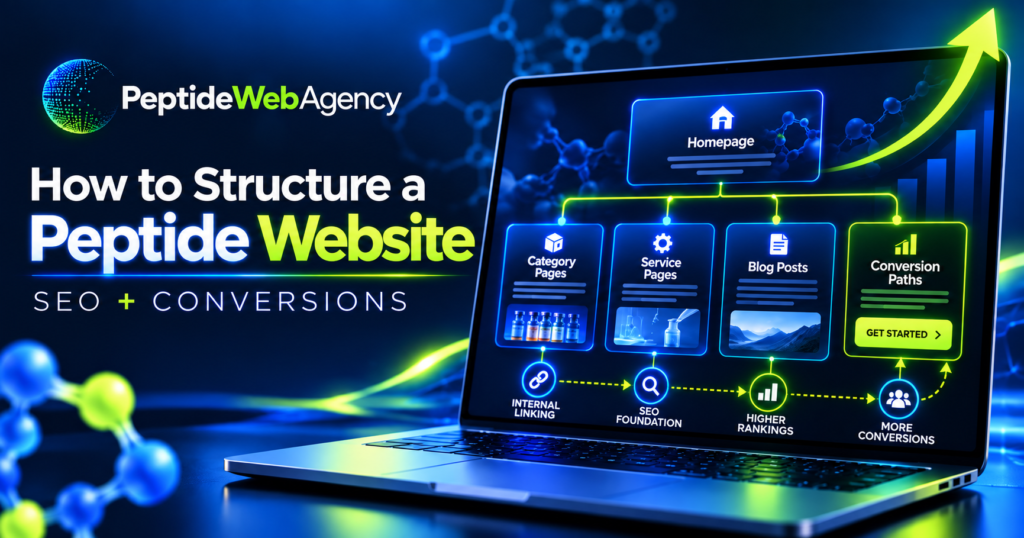
A peptide website can look polished and still struggle to rank, generate enquiries, or turn visitors into customers.
Often, the problem is not the design.
It is the website structure.
When pages are difficult to find, product categories are confusing, or blogs are disconnected from service pages, visitors get lost and search engines receive weaker signals about what the website is actually about.
A strong peptide website should make one thing easy: moving from information to action.
If you’re still planning your overall website, start with our complete Peptide Website Development Guide. It covers the broader foundation, including design, ecommerce, SEO, performance, trust, and email marketing.
This article focuses on the next step: structuring those pages properly.
What Is a Good Peptide Website Structure?
A good website structure organizes pages in a way that makes sense to both visitors and search engines.
A simple version looks like this:
Homepage → Main Category or Service → Individual Page → Supporting Content
For an ecommerce peptide business, that might be:
Homepage → Product Category → Product Page → COA or Supporting Information
For a service-based peptide company, it may look like:
Homepage → Service → Supporting Blog → Consultation
The structure should feel obvious.
Visitors should not need to think about where to click next.
Keep Your Most Important Pages Easy to Reach
Important pages should not be buried five clicks deep.
Your main navigation should usually give users fast access to the pages that matter most.
For a peptide business, those may include:
- Main products or services
- Product categories
- Testing or COA information
- About page
- Contact page
- Educational resources
- FAQs
- Important policies
The same principle applies to PeptideWebAgency.
Our core services each have their own dedicated page:
Why separate pages?
Because someone searching for website development has a different goal from someone looking for SEO or email marketing.
Giving each service its own page makes the website clearer for both the user and the search engine.
Give Each Search Intent Its Own Page
One of the biggest SEO mistakes is asking one page to rank for everything.
Imagine a single services page trying to rank for:
- Peptide website development
- Peptide SEO
- Peptide ecommerce
- Peptide email marketing
- Conversion optimization
That page becomes too broad.
A better approach is to give important topics their own focused pages and then connect them through internal links.
For example, this website-development cluster currently contains:
Pillar article:
Peptide Website Development: The Complete Guide for Peptide Brands
Supporting article:
Why Most Peptide Websites Fail to Convert Visitors
Supporting article:
How to Structure a Peptide Website for SEO and Conversions
Now these articles are not isolated.
They support one another.
That helps build a stronger topical structure around peptide website development.
Why Internal Linking Matters
Internal links are simply links from one page on your website to another.
But when they are used properly, they do much more than help people navigate.
They show the relationship between different topics.
For example, if we are discussing organic traffic, it makes sense to send the reader to our Peptide SEO service.
If the subject is product pages, checkout, categories, or online stores, Peptide Ecommerce Development is more relevant.
If the conversation is about user experience or development, Peptide Website Design becomes the natural next page.
The key word here is natural.
You do not need to force the same keyword into every paragraph.
A useful link should help the reader continue their journey.
Organize Ecommerce Categories Carefully
Ecommerce stores can become messy quickly.
A website with dozens or hundreds of products needs a structure people can understand.
A simple hierarchy often works better:
Homepage → Category → Product
Avoid adding unnecessary subcategories simply because you want another SEO page.
A category should serve a real purpose.
If a visitor would genuinely use it to narrow down products, it probably makes sense.
If it exists only to target another variation of a keyword, reconsider it.
Good Peptide Ecommerce Development should make product discovery easier, not create more clicks.
Every Blog Needs a Next Step
This is where many business blogs fail.
Someone finds an article through Google, reads it, reaches the bottom and leaves.
Why?
Because the article never gave them a meaningful place to go.
Every blog should have a logical next step.
For example, someone reading this article may want to:
- Learn the full website-development process
- Understand why their current website is not converting
- Explore a relevant service
- Book a consultation
That is why we have linked this article to our complete peptide website development guide and our guide on why peptide websites fail to convert.
This is how a topic cluster starts becoming useful for both SEO and real visitors.
SEO and Conversion Structure Should Work Together
Ranking is not the final goal.
You want the right person to reach the right page and then know what to do next.
Your Peptide SEO strategy may bring a potential customer into the website through a blog article.
From there, the website should guide them toward another useful resource, a relevant service, or a consultation.
And if they are not ready to take action immediately, Peptide Email Marketing can give you another way to continue the relationship.
That is why SEO, website structure, ecommerce, and email should not be treated as completely separate systems.
They support the same customer journey.
Quick Peptide Website Structure Checklist
Before creating more pages, check your existing website.
Ask yourself:
- Can visitors reach important pages easily?
- Does every major topic have a dedicated page?
- Are related blogs linked together?
- Do blogs link to relevant commercial pages?
- Are your product categories simple and logical?
- Does each article have a clear next step?
- Can users find important trust information quickly?
- Is the contact or booking option easy to reach?
If several answers are no, your website structure may need attention before you add more content.
Build a Website That Feels Connected
A strong peptide website should not feel like a random collection of pages.
Your service pages should connect to your blogs.
Your blogs should connect to relevant supporting articles.
Your product pages should connect to categories and helpful documentation.
Your SEO content should lead people toward something useful.
When those relationships are planned properly, the site becomes easier to use and easier to grow.
That is what good website architecture is really about.
Not adding more pages.
Connecting the right pages.
Want to Improve Your Peptide Website Structure?
If your peptide website feels difficult to navigate, is struggling to rank, or gets traffic without enough conversions, the structure may be part of the problem.
We can review your website, SEO, ecommerce journey, and conversion paths together.
Book a Free 30-Minute Consultation With PeptideWebAgency
Frequently Asked Questions
What is the best structure for a peptide website?
A simple structure usually works best: homepage, main categories or services, individual product or service pages, and supporting educational content. Important pages should be easy to reach without forcing visitors through unnecessary layers.
Why are internal links important for peptide SEO?
Internal links help users discover related content and help search engines understand how pages are connected. They are especially useful when linking supporting articles back to pillar pages and relevant services.
Should every peptide service have its own page?
Usually, yes, when each service targets a different search intent. Dedicated pages allow you to explain each service clearly and optimize the page around a focused topic.
Should peptide blogs link to older blogs?
Yes, when the topics are related. This article, for example, connects naturally with the Peptide Website Development Guide and the article explaining why peptide websites fail to convert.
How many internal links should a blog have?
There is no perfect number. Add links where they genuinely help the reader. A 1,000-word article may naturally contain several internal links without needing to repeat the same destination excessively.